




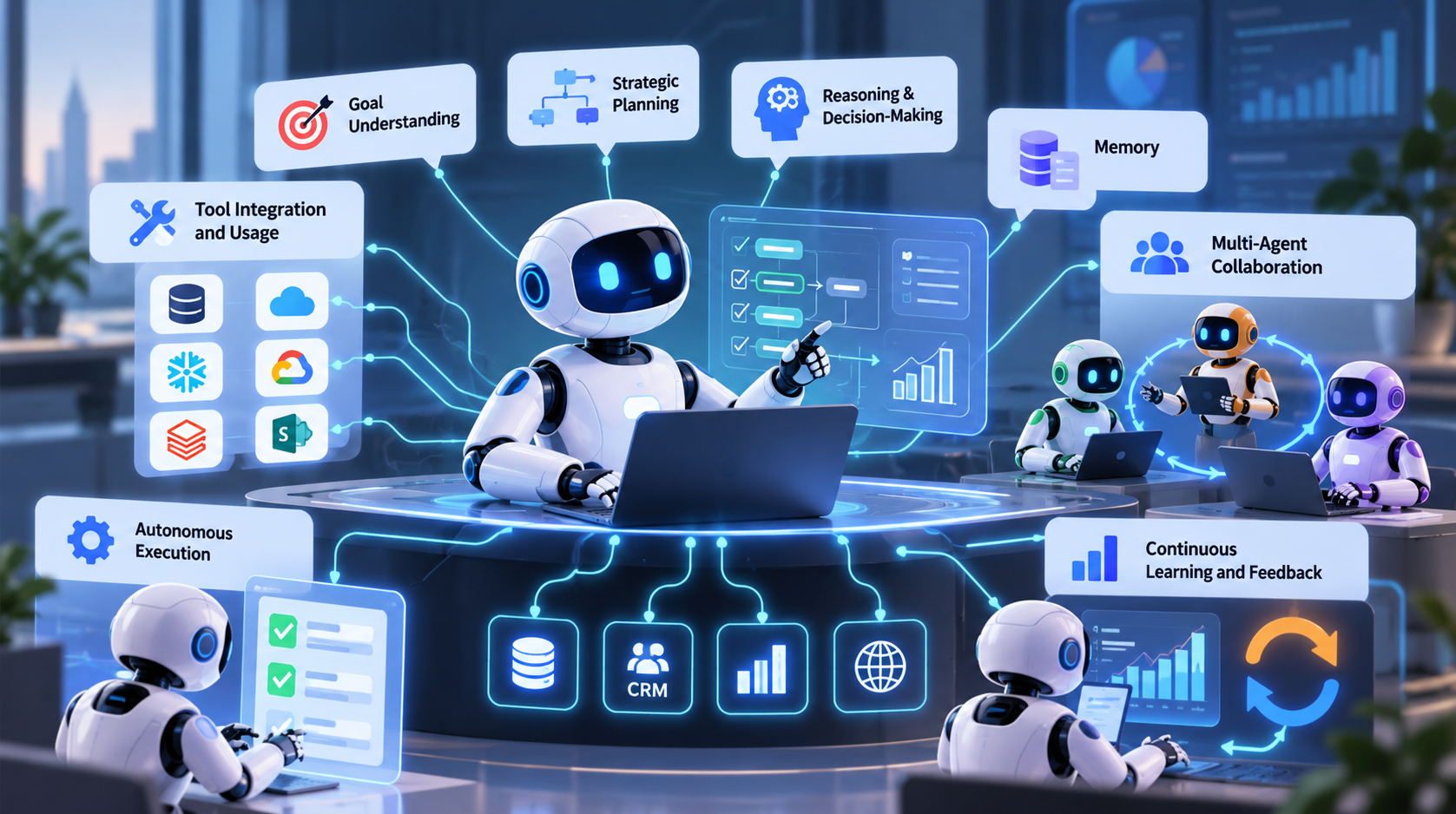
The Likely Future Evolution of Agentic Systems in AI
Agentic systems represent one of the most significant advancements in artificial intelligence today. Typically, AI systems are designed to perform specific tasks, such as answering questions, classifying data, or making predictions based on input. In contrast, an agentic AI system can understand objectives, planning actions, making decisions, interacting with external tools, and executing complex workflows with minimal human intervention. These systems elevate AI from a passive assistant to an active participant in problem-solving and business management.
The Role of Agents
At the core of every agentic system is an intelligent AI agent. An agent is a software entity that perceives its environment, processes information, and takes action to achieve a specific goal. Unlike conventional software that follows fixed instructions, AI agents can reason through problems, evaluate alternatives, and adapt their behaviour based on changing data or circumstances. This adaptability makes them highly effective in dynamic environments where predefined rules may fall short.
Goal Understanding
One of the most important capabilities of an agentic system is goal comprehension. When a user provides a task request, the agent first interprets the objective and identifies the desired outcome. For example, if a business manager asks for a quarterly sales forecast, the agent does not simply provide a generic response. Instead, it understands that achieving the goal requires gathering historical sales data, analysing trends, applying forecasting techniques, and presenting the results in an accessible format. This translation of natural language instructions into actionable objectives is a defining feature of agent-based AI.
Strategic Planning
After understanding the goal, the agent develops a plan to achieve it efficiently. Planning involves breaking a complex objective into smaller, manageable tasks and determining the optimal sequence for executing them. In a research project, for instance, an agent might first collect information from multiple sources, then analyse the findings, generate insights, and finally prepare a comprehensive report. This structured approach allows the agent to handle sophisticated workflows that would otherwise require significant human effort and coordination.
Reasoning and Decision-Making
Reasoning and decision-making are fundamental elements of agentic systems. Agents continuously evaluate available information, compare possible actions, and select the most appropriate course of action. When unexpected situations arise, the agent can adjust its strategy accordingly. For example, if a preferred data source becomes unavailable, the agent can quickly identify alternative sources and continue the task without interruption. This capability enables agents to operate effectively in real-world environments where uncertainty and change are common.
Memory in Agentic Systems
Memory is another critical component of advanced agentic systems, allowing agents to retain information about previous interactions, completed tasks, and user preferences. Short-term memory helps maintain context during an ongoing task, while long-term memory stores historical knowledge that can be referenced in future interactions. For businesses, this means agents can provide highly personalized recommendations, improve customer experiences, and make better decisions based on accumulated knowledge over time.
Tool Integration and Usage
Modern agentic systems are capable to leveraging external tools and applications as needed. Through integrations with databases, enterprise software, APIs, search engines, and analytics platforms, agents can access real-time information and perform actions far beyond simple text generation. For example, a sales agent could retrieve customer profiles from a CRM system, analyse purchasing patterns, generate a comprehensive sales report, and automatically email it to management. This ability to interact with external ecosystems transforms AI agents into powerful digital workers capable of executing end-to-end business processes.
Multi-Agent Collaboration
Many advanced implementations utilize multiple specialized agents working in tandem. In a multi-agent system, different agents are assigned specific responsibilities based on their expertise. One agent might focus on data collection, another on analysis, a third on forecasting, and a fourth on report generation. By collaborating and sharing information, these agents can solve complex problems far more efficiently than a single agent working alone. This collaborative architecture closely mirrors how human teams operate within organizations
Autonomous Execution
Autonomous execution is what truly distinguishes agentic systems from traditional automation solutions. Once a goal is defined, the agent can carry out tasks independently, monitoring its own progress and adapting to changing conditions along the way. Human involvement is required only when high-level strategic decisions or approvals are needed. This degree of autonomy enables organizations to automate routine activities, reduce operational costs, improve efficiency, and maintain continuous, round-the-clock operations.
Continuous Learning and Feedback
Learning and adaptation continuously enhance the effectiveness of agentic systems. Through feedback mechanisms and performance evaluations, agents improve their decision-making processes over time. By analysing past successes and failures, they learn which strategies produce the best results and refine their behaviour accordingly. This ongoing improvement ensures that AI systems become more accurate, efficient, and valuable as they gain real-world experience.
Transforming Industries
Agentic systems are already transforming sectors such as finance, healthcare, manufacturing, logistics, research, and customer service. Businesses rely on AI agents to forecast demand, optimize supply chains, analyse market trends, automate customer support, and accelerate innovation. Researchers employ agent-based systems to process vast volumes of scientific literature, identifying new opportunities for discovery. As AI technology advances, agentic systems are poised to become a foundational component of global digital transformation strategies.
Conclusion
Agentic systems represent the next generation of artificial intelligence. By combining goal understanding, planning, reasoning, memory, tool integration, collaboration, autonomous execution, and continuous learning, these systems enable AI to function as intelligent digital workforce members rather than simple software tools. Organizations that successfully adopt agentic systems will benefit from increased productivity, faster decision-making, enhanced innovation, and a significant competitive advantage in a rapidly evolving digital economy.